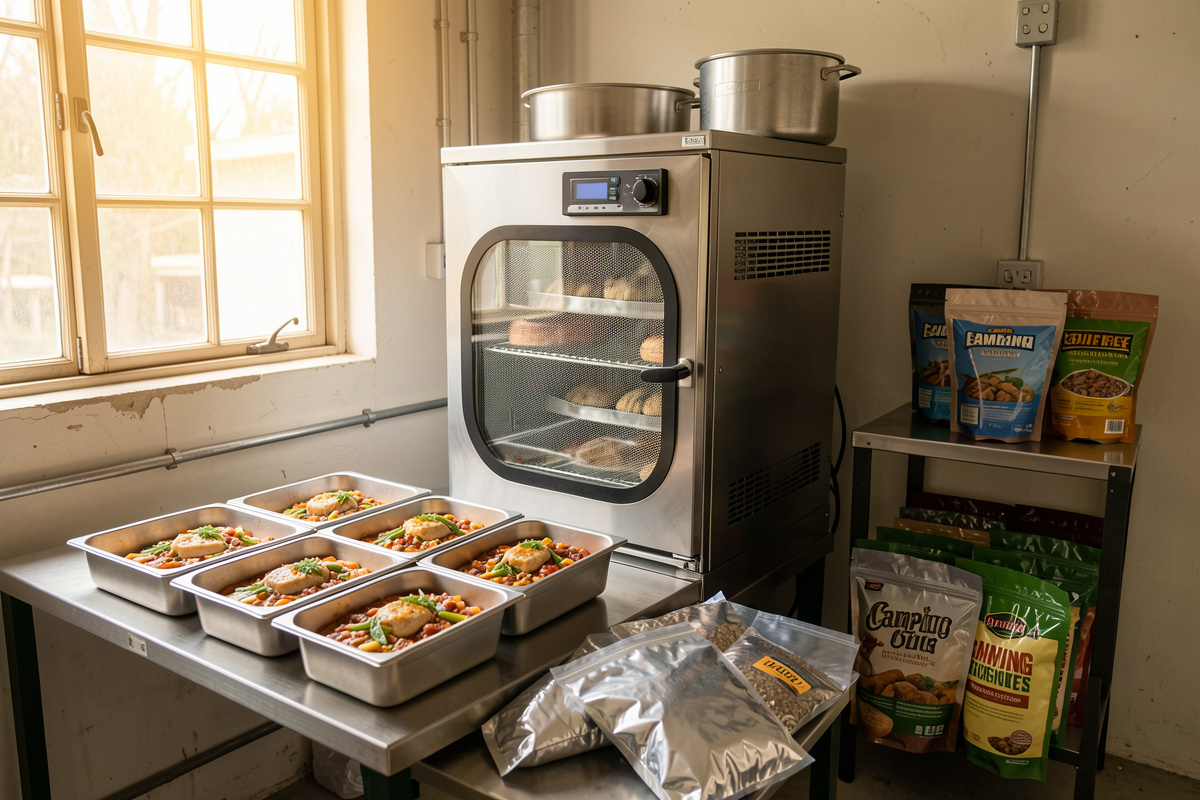

A freeze dried meal is a complete, cooked dish with the water pulled out by sublimation instead of heat — which is why a 600-gram serving of stew leaves my trays weighing under 130 grams and rehydrates in the field with a cup of hot water. This freeze dried meals guide is the one I wish I’d had before my first meal load gummed three trays.
I run a Harvest Right Medium-class machine in my utility room, and I’ve logged every meal batch I’ve put through it — load weight, pre-freeze, cycle time, final dry check, packaging. Meals are a different animal from single-ingredient loads like sliced strawberries. They’re wetter, denser, and more forgiving of mistakes you can’t see until you rehydrate them three months later. This page is the map: how meals behave in the chamber, how to prep them so they actually dry, how to store them, and where the honest economics land. Every deeper question has its own page linked below.
What Counts as a Freeze Dried Meal
A freeze dried meal is any cooked, assembled dish — chili, curry, pasta sauce, breakfast scramble — processed as a unit rather than as separate ingredients. The win is weight and shelf stability: removing roughly 95% of the water by sublimation drops pack weight by two-thirds or more while keeping the structure and most of the nutrition intact.
That last part is what separates freeze drying from dehydrating. A dehydrator drives water out with heat, which collapses cell walls and case-hardens the surface. A freeze dryer freezes the food solid first, then pulls the chamber down to a deep vacuum so the ice goes straight from solid to vapor. The food keeps its shape, its color, and most of its flavor compounds. When I rehydrate a logged batch of beef stew, the carrots come back as carrots, not the leathery brown chips a dehydrator gives me. If you want the full method-by-method breakdown, I put it in freeze drying vs every other preservation method.
Meals split into a few practical families: wet stews and curries (highest water, longest cycles), pasta and grain dishes (medium), and dry-assembled backpacking builds where you freeze-dry components separately and combine them dry. Each one loads and dries differently, and getting that wrong is the single most common reason a meal batch fails the final dry check.
Prepping a Meal So It Actually Dries
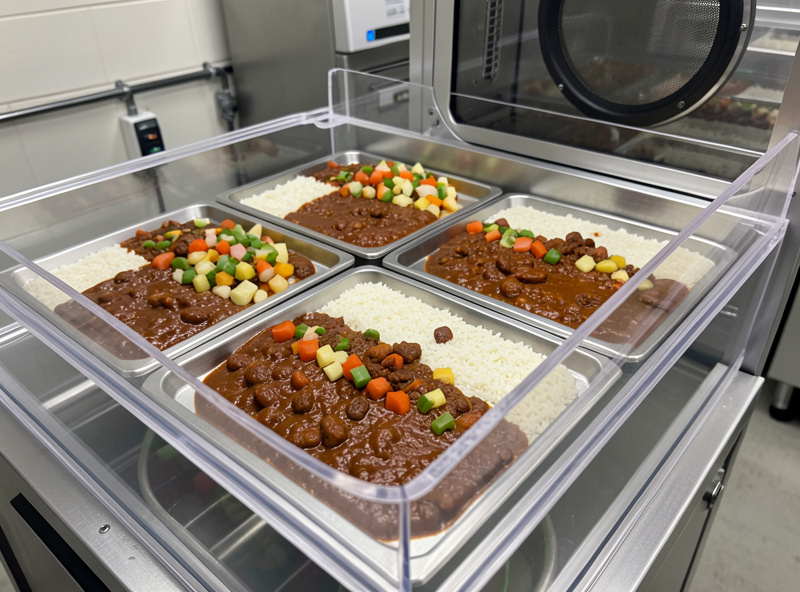
The biggest difference between a meal batch that dries clean and one that fails the snap test is decided in the kitchen, before the trays ever go in. I cook meals destined for the freeze dryer a little differently than meals for the table: smaller pieces, slightly under-cooked starches, and as little free oil as I can get away with.
Three rules carry most of the weight. First, cut everything small — centimeter dice on meat and vegetables, because a big chunk of stew meat has a frozen core that sublimates last and is the piece most likely to hide moisture. Second, par-cook pasta and rice so they finish cooking on rehydration instead of arriving on the trail already mushy; fully cooked grains freeze-dry fine but rehydrate to a softer texture. Third, skim the fat. Oil does not freeze and does not sublimate, so a layer of grease on top of a chili is the part that goes rancid in storage and the part that gums the trays. I make a leaner version of a recipe specifically for the machine and add fats back at the table if I want them.
Some things simply do not belong in a freeze dryer, and learning that from the log saved me wasted cycles. Pure oils and butter never dry. Very high-sugar sauces stay tacky. Dense peanut-butter-style spreads gum the trays the way candy does without the payoff. When a dish is mostly fat or sugar, it is a better candidate for the freezer or the fridge than the chamber, and that decision tree is exactly what freeze drying vs every other preservation method walks through.
Portioning happens at prep time too, not after. I decide whether a dish will be packed as a single trail dinner, a two-person camp meal, or a pantry portion before it hits the trays, because the portion size drives the bag size, the oxygen-absorber size, and how I label it. Deciding that on the back end, after everything is dry and fragile, is how you end up crushing a batch trying to repackage it.
How Meals Behave in the Chamber
Meal batches run longer than single ingredients — in my log a tray-set of wet stew averages 36 to 44 hours against roughly 20 to 28 for sliced fruit, because sauce holds water in places the vacuum reaches last. The fix is tray discipline, not patience.
The two levers that decide a meal cycle are layer thickness and load weight. Spread chili a centimeter deep across the tray and the ice front has a short distance to travel; pile it three centimeters deep in the middle and the core is still releasing water long after the edges are bone dry. I keep meals thin and even, and I weigh every tray-set so the cycle times in my log actually mean something. My full notes on this live in freeze dryer tray loading density rules and how long freeze drying really takes.
Pre-freezing is the other free win. If I drop loaded trays into the chest freezer overnight before they go in the machine, the freeze dryer skips its own slow freeze stage and starts pulling vacuum on already-solid food. That can shave hours off a meal cycle and it makes the cycle more consistent batch to batch — the reasoning is in pre-freezing before freeze drying. For saucy dishes that want to slide off the tray, the tray-liner and pre-freeze trick in freeze drying liquids on trays is what keeps the load clean.
The Dry Check Is Non-Negotiable for Meals
A meal that looks dry on the surface can hide soft, cold spots in the densest portions — and residual moisture is what turns a stored meal rancid or moldy. I never trust the machine’s timer on a meal load; I trust the snap test, the temperature of the thickest piece, and the weight against my log.
My three checks are simple and I run all three. First, snap a piece from the densest part of the load — it should fracture, not bend. Second, feel it; any piece that feels cooler than the room is still holding moisture and sublimating. Third, weigh the tray-set and compare it to the dry weight my log predicts for that food. If any check fails, the load goes back in for more time. I wrote the whole routine up in how to tell if freeze drying is done, and the re-run criteria in when to add extra dry time. With meals, I’d rather run an extra four hours than seal a batch I have to throw out.
Storing Freeze Dried Meals
The framing that matters more than any number: freeze dried meals keep when they are sealed in clean, dry storage with oxygen absorbers, away from light and heat. Storage is what protects the work the machine did — a perfectly dried meal in a leaky bag is a wasted batch.
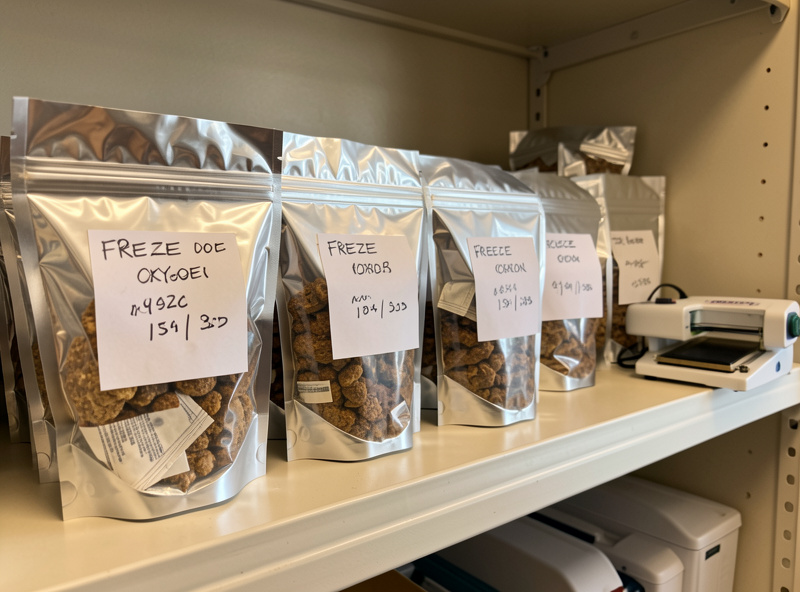
My packaging line is unglamorous and consistent. Fully dried meals go into food-grade mylar bags with oxygen absorbers sized to the portion, sealed with an impulse sealer, then labeled with the food and the date. Short-cycle items I’ll be eating within a few weeks — trail snacks, the next camping trip’s lunches — go in jars instead, because constantly re-opening a big mylar bag defeats the oxygen absorber. As an Amazon Associate I earn from qualifying purchases.
On shelf life, I stay careful on purpose. Manufacturers commonly state that properly freeze dried and sealed food can last many years, and that’s plausibly true for low-moisture, well-packaged single ingredients. For the official rules on safely drying, storing, and handling food I defer to USDA food-safety guidance rather than any single shelf-life claim. Meals are harder — fats and oils in a cooked dish go rancid long before the dry starch does. So I treat oily meals as a shorter-rotation item and lean dishes as the long-keepers, and I rotate by the date on the label rather than trusting a headline number. The complete storage method is in how to store freeze dried food, and the home-meal specifics are in how long homemade freeze dried meals last.
The Packaging Line and Equipment
You can run a freeze dryer with almost no extra gear, but the packaging side is where a small kit pays off, because sealing is the step that decides whether the batch survives storage. My line is four things: bags, oxygen absorbers, a sealer, and a labeling system — nothing exotic.
For bags I match the size to the portion. A single trail dinner goes in a quart-class mylar pouch; a pantry portion of chili goes in a larger bag. Right-sizing the bag matters because the smaller the headspace, the less air the oxygen absorber has to scrub. I keep a few sizes of food-grade mylar bags and matching oxygen absorbers on the shelf and size the absorber to the bag volume rather than guessing. An impulse sealer makes a clean, repeatable weld across the top of a mylar bag in a second; a hair-straightener works in a pinch but the seal is less consistent, and a consistent seal is the whole point.
Jars earn their place for the short-rotation items — the snacks and next-trip meals I open and close repeatedly. Every time you open a mylar bag you spend part of its oxygen absorber, so anything I’m grazing from lives in a jar with its own small absorber. The labeling system is the least glamorous and the most important: food name and seal date on every container, rotated oldest-first. Without that, you end up with an anonymous shelf of silver bags and no idea what’s in them or how old they are. The full method, including how I think about absorber sizing, is in how to store freeze dried food.
Meals for Camping and the Trail
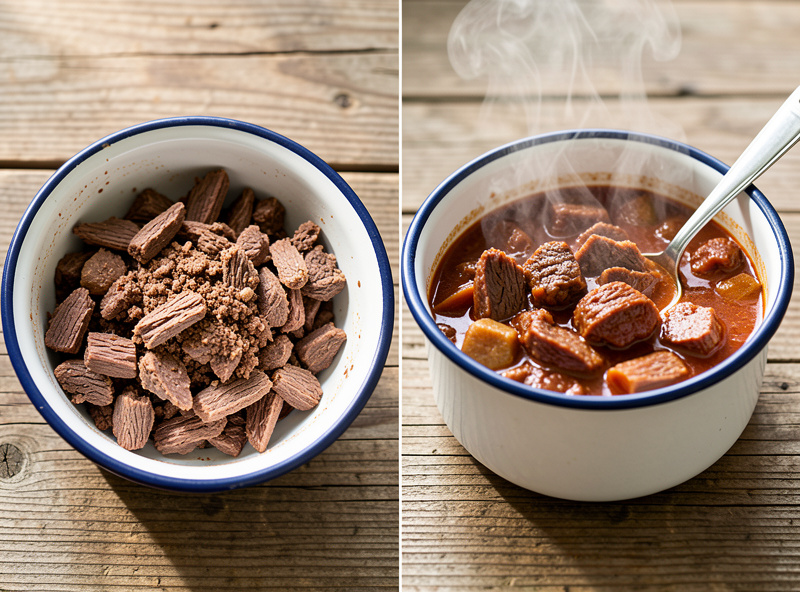
Freeze dried meals earn their place fastest in a backpack, because the machine removes exactly the thing you carry on your back: water. A two-thirds weight reduction on a week of dinners is real, measurable load off your shoulders — and unlike most store-bought trail food, you control the recipe, the sodium, and the portion size.
The skill that separates a good trail meal from a sad one is prepping the dish so it rehydrates cleanly in cold-tired-hungry field conditions. That’s its own discipline — cooking the dish slightly softer than normal, keeping pieces small, and packaging in single-meal portions. I broke the whole workflow out into freeze dried meal prep for camping. Calorie density matters even more than weight once you’re moving all day; the math on packing the most usable energy per gram is in calorie-dense freeze dried backpacking meals. And rehydrating in the field — how much water, how long, hot versus cold soak — trips up more people than the drying ever does, so I gave it a full page: rehydrating freeze dried meals in the field.
Homemade vs Commercial Meals
The honest answer is that commercial pouches win on convenience and consistency, and home batches win on cost-per-serving, portion control, and knowing exactly what’s in them — once you’ve absorbed the machine cost. A commercial backpacking entrée routinely runs several dollars a serving; my logged cost on a home batch, ingredients only, is a fraction of that.
But the machine isn’t free, and neither is my time or the electricity. Here is how I actually think about it: a tray-set of home stew might cost me a modest amount in ingredients and a chunk of electricity for a day-plus cycle, and it yields several sealed dinners. Against a commercial pouch that costs several dollars each, the per-serving gap is real — but you only close the machine’s purchase price over many, many batches, and only if you keep running it. A freeze dryer that sits idle eleven months a year never gets there. I don’t pretend it “pays for itself in months” — whether it pays off at all depends entirely on how much you actually run it and whether your inputs are garden glut or grocery-bought. I laid the real comparison out in freeze dried vs store-bought camping food, and the broader ownership math in freeze dryer running costs and cost per serving. If you want to build your own trail menu from scratch, the recipe-and-method walkthrough is making your own freeze dried backpacking food.
| Meal type | Typical cycle (Medium tray-set) | Rehydration time | Best storage | Rotation note |
|---|---|---|---|---|
| Wet stew / chili | 36–44 hours | 10–15 min hot water | Mylar + O2 absorber | Lean versions keep longest |
| Pasta / grain dish | 28–36 hours | 8–12 min hot water | Mylar + O2 absorber | Watch oily sauces |
| Breakfast scramble | 24–32 hours | 5–10 min hot water | Mylar + O2 absorber | Cheese/fat shortens life |
| Assembled trail build (dry components) | Varies by component | Soak per component | Single-meal mylar pouch | Most flexible to pack |
| Soup / broth (liquid) | 30–40 hours | Stir into hot water | Jar or mylar | Use tray liners |
When a Meal Belongs on a Different Bench
Freeze drying is the loudest, hungriest tool in my preservation line, and it is not always the right one. The honest operator question is not “can I freeze dry this meal” but “is freeze drying the best home for it,” and often the answer is no.
If a dish is going to be eaten this week, the fridge or the regular freezer wins outright — you spend no cycle time and lose no texture. If the goal is flavor transformation rather than storage, that is fermentation’s job, not the chamber’s. A cut of meat you want to keep without a meal attached is often better cured than dried. I run all of those benches, so I can say without marketing spin that the freeze dryer is the right answer specifically when you want long shelf-stable storage, the lightest possible pack weight, or a meal that rehydrates close to fresh — and the wrong answer when any cheaper, quieter method gets you what you actually need. Picking the tool honestly is the whole reason I keep the log: it tells me what each bench is genuinely good at instead of what I hoped it would be. For the authoritative home-preservation reference behind these method choices, the National Center for Home Food Preservation is where I check the science.
Meals with a lot of dairy, cheese, or oil sit in the grey zone. They can be freeze dried, but they store shorter and I treat them as eat-soon items rather than multi-year pantry stock. When in doubt, I default to the framing that has never failed me: dry it properly, seal it in clean, dry storage with oxygen absorbers, label the date, and rotate — and don’t ask a meal to keep longer than its fattiest ingredient will allow.
Building a Meal Routine That Lasts
The owners who get value out of meal freeze drying are the ones who batch on a schedule and log it. A one-off meal load is a novelty; a standing routine — Sunday cook, Monday load, mid-week seal — is what fills a pantry and a pack without the kitchen ever feeling like a factory.
I treat it the way I treat my curing chamber and my fermentation crocks: same trays, same weights, same log, so the data compounds. Fermentation, curing, and freeze drying are really the same hobby at three different water activities — I just keep adding benches to the preservation line. If you’re still choosing your first meal loads, start with the proven ones in the best first freeze dryer batch before you tackle a wet, oily stew. Get the routine boring and repeatable, and the machine quietly does what the marketing promised — just slower, louder, and on your terms.
Frequently Asked Questions
How long do freeze dried meals take to make?
A wet meal like stew or chili runs 36 to 44 hours on a Medium-class machine in my batch log, versus 24 to 32 for a drier breakfast scramble. Pre-freezing and thin, even tray loading shorten the cycle and make it more consistent.
Do homemade freeze dried meals really last for years?
Manufacturers commonly state properly dried and sealed food can last many years, but meals are harder than single ingredients because fats and oils go rancid first. Store in clean, dry mylar with oxygen absorbers, keep oily dishes as shorter-rotation items, and rotate by the date on the label.
What is the difference between freeze dried and dehydrated meals?
Freeze drying freezes the food then sublimates the ice in a vacuum, keeping shape, color and most nutrition. Dehydrating uses heat, which collapses texture and case-hardens the surface. Freeze dried meals rehydrate faster and more completely.
Can you freeze dry any cooked meal?
Most cooked dishes work, but high-fat and high-oil meals dry slower and store shorter, and very thick saucy loads must be spread thin to dry through. Pure oils and high-sugar items do not freeze dry well at all.
How do you store freeze dried meals after drying?
Seal fully dried meals in food-grade mylar bags with oxygen absorbers, sized to the portion, then label with the food and date. Use jars only for items you will finish within a few weeks. Keep everything away from light and heat.
Are homemade freeze dried meals cheaper than commercial pouches?
Ingredient cost per serving is a fraction of a commercial backpacking pouch, but that ignores the machine, electricity and your time. Whether it pays off depends on how often you run the machine and whether your inputs are garden glut or grocery-bought.