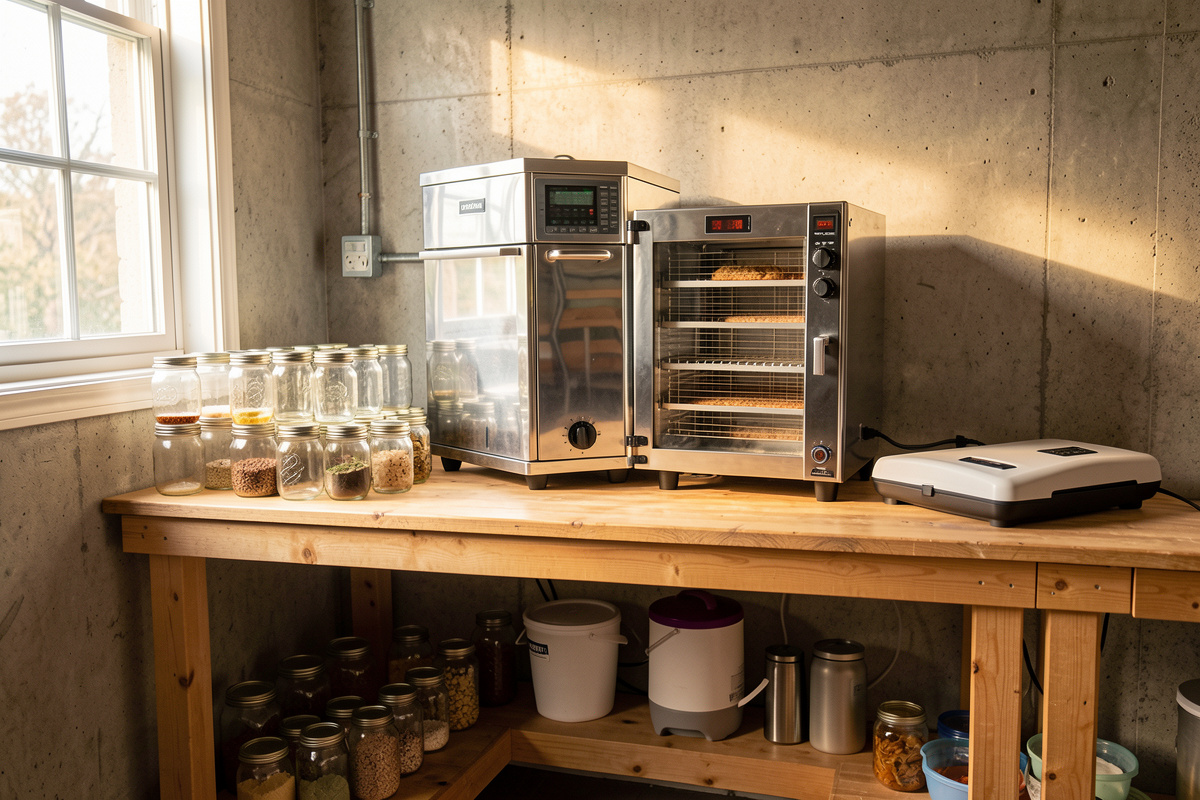

If you only remember one thing from this guide, remember this: freeze drying, dehydrating, canning, and vacuum sealing are not competing products — they are four different jobs. Freeze drying removes around 98-99% of a food’s moisture by sublimation, which is why manufacturers like Harvest Right cite shelf lives measured in decades; dehydrating removes roughly 90-95% with heat and gets you one to two years; canning preserves with heat and a seal and the USDA recommends eating it within a year; vacuum sealing barely preserves at all on its own — it just slows the clock in your freezer or fridge.
I run a Medium-class home freeze dryer in my utility room, and before it I had — and still have — a dehydrator, a chest freezer, and a canning shelf. This freeze drying vs dehydrating guide, and the honest comparison against canning and vacuum sealing, comes straight from my batch log: years of load weights, cycle times, and the failed loads that taught me more than the manual did. My goal here is not to sell you the loudest machine in the house. It is to tell you which tool actually fits the food in front of you, and to be honest about the cases where the machine I paid four figures for is the wrong answer.
The Short Answer: Match the Method to the Food
The fastest way to choose is to ask what you want out of the food a year from now. Want it shelf-stable, lightweight, and able to rehydrate close to fresh? Freeze drying. Want it shelf-stable and cheap to produce, and you don’t mind chewy texture? Dehydrating. Want jars of ready-to-eat soups, sauces, and pickles with no power draw? Canning. Want to keep something good in the freezer for longer without freezer burn? Vacuum sealing.
No single method wins on every axis. Freeze drying wins on shelf life, nutrition retention, and rehydrated quality. It loses badly on upfront cost, cycle time, and noise. I bought the machine because my garden harvest outruns what my family can eat fresh, and freeze drying is the only method that banks a glut of berries or peas at near-fresh quality. If that’s not your problem, you may not need the most expensive tool on the bench — and I’d rather tell you that now than after you’ve cleared a corner of the utility room for it.
Water Activity: The Number Behind Every Method
Every preservation method on this page is really doing one thing: lowering water activity, the amount of free water available for microbes and chemical reactions. Bacteria, mold, and yeast all need free water to grow, and the lower you push water activity, the longer food keeps. Freeze drying pushes it the lowest by removing nearly all the moisture; dehydrating gets close but not as far; canning doesn’t lower water activity at all and instead relies on heat sterilization plus an airtight seal; vacuum sealing doesn’t touch water activity, which is exactly why it isn’t preservation on its own.
Understanding water activity is what stopped me treating these methods as interchangeable. Fermentation, curing, and freeze drying are the same hobby at three different water activities — I just keep adding benches to the preservation line. Once you see the methods as points on a moisture scale rather than rival gadgets, the right choice for a given food becomes obvious, and you stop trying to force one machine to do every job.
Freeze Drying vs Dehydrating: The Closest Rivalry
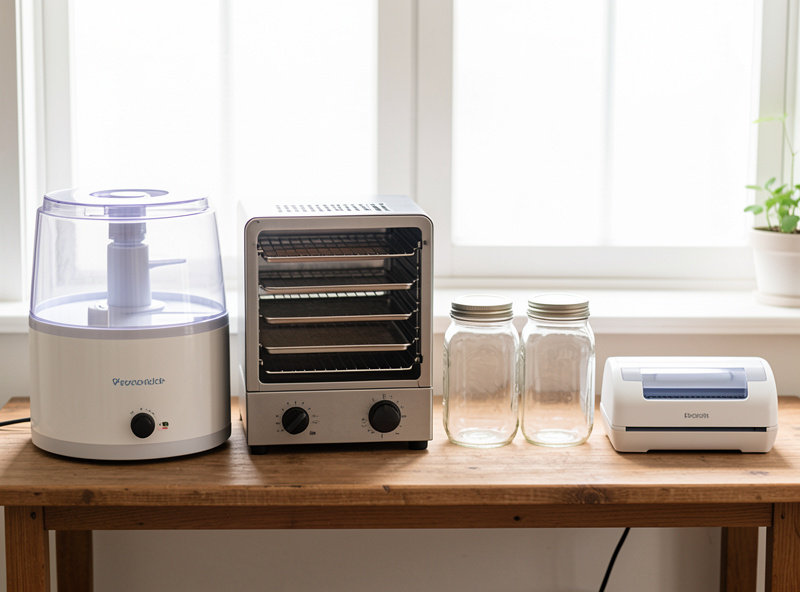
These two get compared most because they look similar on the shelf — both produce dry, shelf-stable food. The difference is how they remove water and what’s left behind. Dehydrating drives moisture out with warm air, which concentrates flavor but also shrinks, toughens, and partially cooks the food. Freeze drying freezes the food solid and pulls the ice straight to vapor under vacuum, leaving the cell structure intact. That’s why a freeze-dried strawberry rehydrates back to something close to a strawberry, while a dehydrated one stays a chewy chip.
In my batch log the practical split is simple. Herbs, jerky, fruit leather, and apple chips go in the dehydrator — it’s cheaper to run and the texture is the point. Anything I want to rehydrate into a meal — peas, corn, cooked meals, dairy — goes in the freeze dryer. The other honest difference is time and effort: a dehydrator runs a few hours and needs no maintenance, while a freeze dryer runs a 20-to-40-hour cycle and the pump needs oil changes. I dig into the full breakdown, including the cost-per-batch math that surprises most people, in my freeze drying vs dehydrating comparison.
Freeze Drying vs Canning: Two Different Pantries
Canning and freeze drying solve almost opposite problems. Canning gives you wet, ready-to-eat food in jars — soups, tomatoes, pickles, jams — with zero power draw once sealed. Freeze drying gives you dry, lightweight food that needs water added back before it’s a meal. I lean on canning for high-acid and wet foods where the USDA has tested, validated processes, and I lean on freeze drying for everything I want light, long-lived, or rehydratable on demand.
There is a hard safety line here I won’t cross: low-acid canning (vegetables, meats, anything not naturally acidic) requires a tested pressure-canning process, and that’s a job for USDA and National Center for Home Food Preservation guidance, not a blog. Freeze drying sidesteps the botulism risk that makes canning unforgiving, but it has its own discipline — moisture left in a load is what spoils it. The two also store completely differently: a shelf of mason jars is heavy, breakable, and space-hungry, while the same calories freeze-dried weigh a fraction and stack flat in mylar. My full freeze drying vs canning comparison lays out which foods belong in which pantry.
Freeze Drying vs Vacuum Sealing: Not Even the Same Category
This is the comparison people get most wrong. Vacuum sealing is not a preservation method on its own — it’s a packaging step. Sucking the air out of a bag slows oxidation and freezer burn, but the food inside is still raw or cooked food that will spoil at room temperature. Vacuum-sealed steak in the freezer lasts longer; vacuum-sealed steak on the counter still rots.
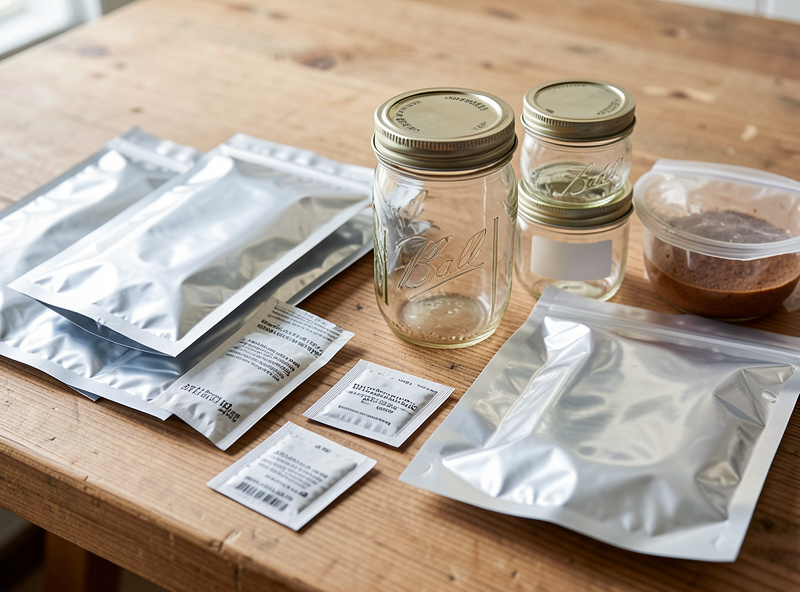
Where the two actually meet is the packaging line. I vacuum-seal nothing for long-term shelf storage; I use mylar bags and oxygen absorbers, which do a different job — they create a barrier and remove the oxygen that fuels spoilage and rancidity. Vacuum sealing pulls air but mylar plus an O2 absorber removes oxygen specifically and blocks light and moisture, which matters because oxygen is what turns fats rancid over years of storage. For the full distinction, see my freeze drying vs vacuum sealing breakdown and my storage guide for how I actually package finished loads.
How the Methods Stack Up
Here is the comparison I wish someone had handed me before I spent the money. The shelf-life figures are manufacturer-stated or USDA-guidance ranges, not my guarantees — storage conditions change everything, which is the whole point of my realistic shelf life piece.
| Factor | Freeze Drying | Dehydrating | Canning | Vacuum Sealing |
|---|---|---|---|---|
| Moisture removed | ~98-99% (sublimation) | ~90-95% (heat) | None (preserved wet) | None (air removed) |
| Shelf life (typical claims) | Up to 25 yrs (mfr-stated, sealed) | 1-2 yrs (NCHFP) | ~1 yr best quality (USDA) | Freezer life extended only |
| Rehydrated quality | Closest to fresh | Chewy / changed texture | Soft, cooked | Unchanged (still raw/cooked) |
| Upfront cost | High ($2,000+ machine) | Low ($50-300) | Low-moderate | Low ($100-200) |
| Power draw | High, 20-40+ hr cycle | Moderate, several hours | Moderate (cooking) | Negligible |
| Best for | Long-term, light, rehydratable | Snacks, herbs, jerky | Wet ready-to-eat foods | Short/medium freezer storage |
Read that table as a job board, not a leaderboard. Each column is the best tool for a different row. The freeze dryer’s only knockout wins are the top three rows; on cost and power it loses to everything, which is exactly why I tell people to be honest about whether they have the volume to justify it. The real total cost is in my running costs breakdown.
Texture and Rehydration: The Test That Settles Arguments
If you ever want to settle the freeze-dry-versus-everything-else argument in your own kitchen, run the rehydration test. Take the same food preserved two ways, add water, and compare. Freeze-dried peas plump back to round and bright in minutes because the cell walls stayed intact through sublimation. Dehydrated peas swell partway and stay a little leathery because the heat collapsed their structure. Canned peas are already soft, sometimes mushy, from the cook. Nothing demonstrates the difference faster than watching the water go back in.
This is also why freeze drying is the only method I trust for foods where texture is the whole point — strawberries that stay strawberry-shaped, sweet corn that tastes like the field, full cooked meals that come back as meals rather than slurry. For snacks where I want chewy and concentrated, the dehydrator is genuinely the better tool. The rehydration test isn’t about which method is best; it’s about which result you actually want on the plate.
Nutrition: What Actually Survives Each Method
Heat is the enemy of nutrients, and this is where freeze drying earns its reputation. Because sublimation happens cold, research on lyophilization consistently reports that freeze drying retains a high proportion of vitamins, color, and bioactive compounds compared with heat-based methods. Canning and dehydrating both apply sustained heat, which degrades heat-sensitive vitamins like vitamin C and some B vitamins.
I won’t put invented percentages on this — nutrient retention varies wildly by food, prep, and storage. What the research community consistently reports is a ranking: freeze drying tends to preserve the most, dehydrating and freezing land in the middle, and canning’s prolonged heat sits at the bottom for heat-sensitive nutrients. There’s a caveat worth stating plainly: a nutrient-rich freeze-dried food stored badly still degrades, so the method only protects nutrition if your storage discipline keeps up. I cover what the studies actually say, and the honest caveats, in my freeze drying nutritional retention piece.
Shelf Life: The Numbers That Are Real
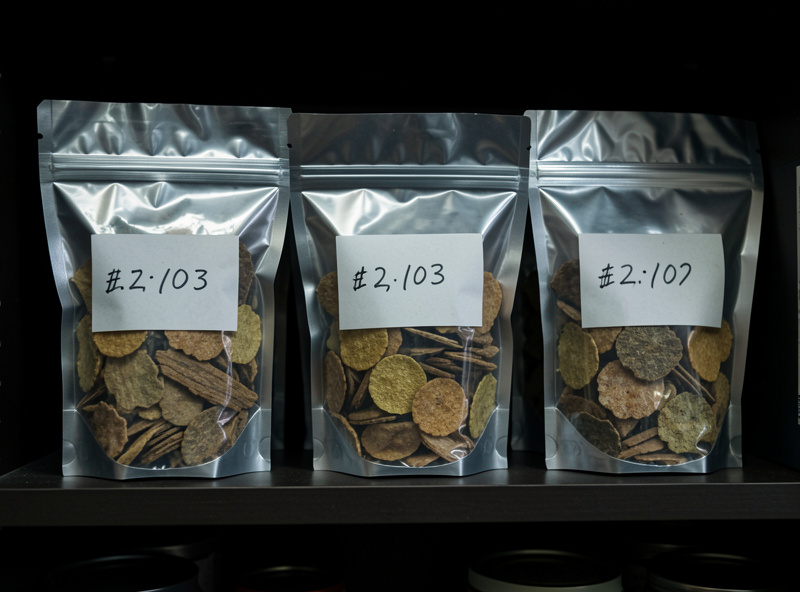
The “25-year shelf life” you see everywhere is a manufacturer claim for freeze-dried food sealed in mylar with oxygen absorbers and stored cool and dark — not a law of physics, and not something I or anyone else has personally verified over 25 years. Treat it as a best-case ceiling, not a promise. The USDA and NCHFP give far more conservative, tested figures for canning (about a year for best quality) and dehydrated foods (one to two years).
What ages food is heat, light, oxygen, and residual moisture. A freeze-dried load with moisture left in it can fail in months regardless of the bag it’s in — which is why my dry-check discipline matters more than the shelf-life sticker. Before I seal a load I verify it against the batch log: the snap-and-crumble check, the weight against the pre-freeze weight, and a re-run if anything’s ambiguous. I keep a separate shelf life and storage conditions guide, and I explain why the marketing number is misleading in realistic shelf life expectations.
Cost: The Math Nobody Likes
A home freeze dryer is the most expensive way to preserve food per pound for most people, full stop. The machine is a four-figure purchase, it pulls real power across a 20-to-40-hour cycle, and the pump needs oil changes. Dehydrating, canning, and vacuum sealing all have a fraction of the entry cost. The freeze dryer only becomes “worth it” when you have volume to feed it — a productive garden, bulk buys, or meal prep at scale.
The honest cost picture also includes consumables most buyers forget: mylar bags, oxygen absorbers, pump oil or a filtration setup, and the power bill across long cycles. None of those are huge individually, but they’re a running cost the dehydrator simply doesn’t have. I run the real cost-per-serving math, garden glut versus grocery-bought, in my cost per serving breakdown — and I’m blunt about the cases where the answer is no in when freeze drying isn’t worth it. If you’re still deciding whether to buy at all, start with my honest ownership reality check and the buying guide. As an Amazon Associate I earn from qualifying purchases. The packaging line — mylar bags and oxygen absorbers — is a small running cost on top of the machine.
What My Batch Log Says About Each Method
The reason I trust this comparison is that I’m not theorizing — I run all four benches and log them. The freeze dryer’s log is full of garden gluts and meal-prep loads that came back near-fresh, alongside the failures that taught me the dry-check discipline. The dehydrator’s record is herbs and jerky that cost almost nothing to make. The canning shelf carries the wet foods nothing else handles as well. And the vacuum sealer’s job is purely to buy my freezer a few extra months.
That whole-bench view is the advantage of this site over the affiliate-review genre, which only ever sells you the machine. Knowing freeze drying’s limits is what makes me trust it for the jobs it’s actually best at. Before any freeze-dry batch, I pre-freeze the load and check expected cycle times so I’m not babysitting the machine blind, and I chose my pump deliberately after weighing the oil versus oil-free trade-offs.
My Decision Tree for Choosing a Method
Here’s how I actually decide, batch by batch. First question: is the food wet and meant to be eaten wet (soup, sauce, pickles)? That’s canning’s job. Second: do I just need it to last a few extra months in the freezer? Vacuum seal it and move on. Third: is it a snack where chewy texture is fine and I want it cheap? Dehydrator. Fourth: do I want it light, long-lived, and rehydratable close to fresh — and do I have enough of it to fill trays? That’s when the freeze dryer earns its noise. If a food fails that last test on volume alone, I don’t run it, however tempting the gadget is.
The point of the whole exercise is to stop romanticizing any one method. The freeze dryer is a brilliant, loud, hungry, expensive tool that is genuinely the best in the house for a narrow set of jobs and badly overkill for everything else. Match the method to the food, be honest about your volume, and you’ll spend your money — and your utility-room space — where it actually pays off.
Freeze Drying vs Plain Freezing: The Forgotten Comparison
Everyone forgets the freezer in these debates, even though it’s the preservation tool already in every kitchen. Freezing is cheap, fast, and keeps food close to fresh — until the power goes out or the food sits long enough to develop freezer burn. The freezer’s two weaknesses are exactly where freeze drying wins: it depends on continuous power, and it slowly desiccates and oxidizes food at the surface over months. Freeze-dried food needs no power once sealed and doesn’t burn.
In my own rotation the two work together rather than compete. The chest freezer is my first stop for a glut I’ll use within a few months and my staging area for pre-freezing loads before they go into the freeze dryer. The freeze dryer is where food graduates when I want it off the power grid and stable for years. If a months-long power cut is a real worry for you, that’s the single strongest practical argument for freeze drying over freezing — your freezer is only as reliable as your electricity, while a sealed mylar bag doesn’t care. For the foods I run most, I lean on the freezer for speed and the freeze dryer for permanence, and I plan loads around realistic cycle times so the machine is never the bottleneck.
Frequently Asked Questions
Is freeze drying better than dehydrating?
Better for long-term storage, nutrition retention, and rehydrated quality, but worse on cost and cycle time. Freeze drying removes about 98-99% of moisture versus 90-95% for dehydrating, so it lasts far longer and rehydrates closer to fresh. Dehydrating wins for cheap snacks and herbs.
Does freeze drying preserve more nutrients than canning?
Research on lyophilization consistently reports that freeze drying retains more heat-sensitive vitamins than canning, because sublimation happens cold while canning applies prolonged heat. Exact retention varies by food, so treat it as a ranking rather than a fixed percentage.
Is vacuum sealing a preservation method?
Not on its own. Vacuum sealing removes air to slow oxidation and freezer burn, but the food inside still spoils at room temperature. It extends freezer or fridge life rather than making food shelf-stable like freeze drying, dehydrating, or canning.
Is the 25-year freeze-dried shelf life real?
That figure is a manufacturer claim for food sealed in mylar with oxygen absorbers, stored cool and dark. It is a best-case ceiling, not a guarantee, and nobody has independently verified 25 years. Residual moisture or poor storage can cut it to months.
Which preservation method is cheapest?
Dehydrating and vacuum sealing have the lowest entry cost, often under a few hundred dollars. Freeze drying is the most expensive per pound for most people because of the machine price, long power-hungry cycles, and pump maintenance. It only pays off at volume.
Can I freeze dry instead of canning everything?
For many foods yes, but not all. Wet, ready-to-eat foods like soups and pickles often suit canning better, and low-acid canning has tested USDA safety processes freeze drying does not replace. Match the method to the food rather than forcing one tool to do every job.