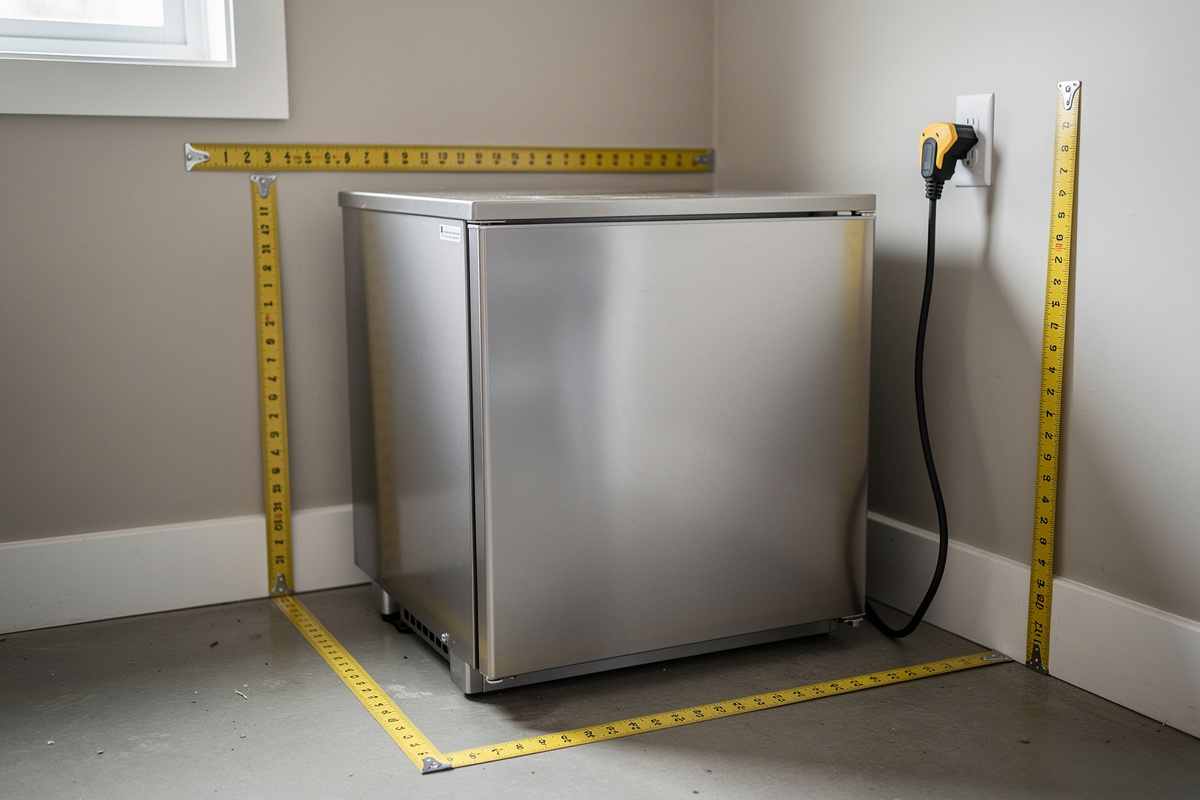

The freeze dryer that ends up homeless in someone’s kitchen was almost always ordered before anyone measured the spot it had to live in. This is the most skippable step in the buying process and the one that causes the most regret — because a freeze dryer isn’t a countertop appliance you slot in wherever there’s room. It’s the heaviest, loudest machine in my preservation line, and it needs a place chosen and measured before it arrives, not improvised after.
This is the pre-purchase measuring guide: what to actually measure, what clearances and services to confirm, and how to be sure the machine fits before you spend four figures. It pairs with the main freeze dryer buying guide. Once the machine is yours and you’re deciding which room wins, my separate guide on where to put a freeze dryer covers living with it; this one is strictly about confirming it fits before you commit.
Measure the machine plus its clearances, not just the machine
The mistake is measuring the unit’s footprint and assuming that’s the space it needs. It isn’t. A freeze dryer needs breathing room — clearance behind and above for airflow and heat, room beside it for the pump, and space in front to open the door fully and slide trays out. The real space requirement is the footprint plus those clearances, and it’s meaningfully bigger than the box dimensions on the spec page.
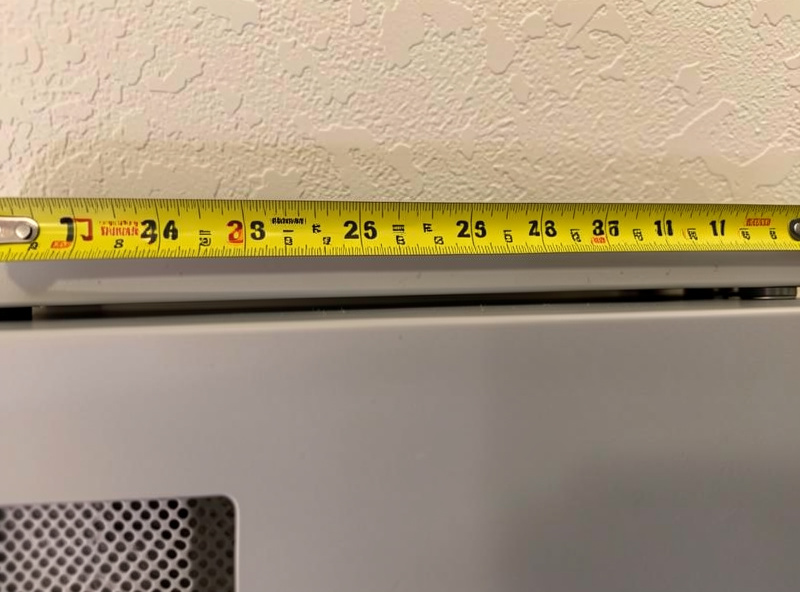
So before you order, take the manufacturer’s stated dimensions for your chosen size and add clearance on every side that needs it. Then go measure your candidate spot against that larger number, including the door’s full swing and tray pull-out depth. If it’s tight, it’s a problem you want to discover now, with a tape measure, not on delivery day with a heavy machine and nowhere to put it.
What to confirm before you order
| What to measure / confirm | Why it matters before buying |
|---|---|
| Footprint + side/rear/top clearance | The real space need is bigger than the box; airflow and heat need room |
| Door swing + tray pull-out depth | You load and unload from the front; cramped depth makes it miserable |
| Doorways and path to the spot | The machine is heavy; confirm it physically gets to the room |
| Electrical: a circuit it can run on | Confirm the outlet and circuit can carry it before delivery, not after |
| Floor strength & levelness | It’s heavy and runs best level; check the surface and support |
| Drainage / drain-pan space | Defrost water needs somewhere to go; plan a pan or drain nearby |
| Noise & heat tolerance of the room | The pump runs for hours; confirm the room can take it |
The electrical check people skip
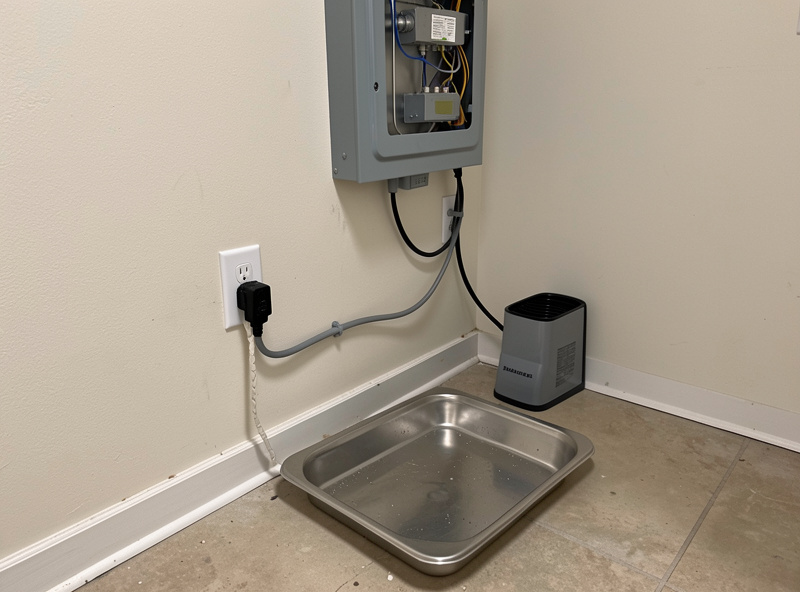
Confirm the machine has a circuit it can actually run on before it shows up. This isn’t usually exotic — home freeze dryers run on standard household power — but you want to know which outlet it’ll use, that the circuit isn’t already loaded with other heavy draws, and that you’re not running it off a marginal extension lead. Check the manufacturer’s stated electrical requirements for your specific size against the outlet you intend to use. If anything about your wiring is uncertain, that’s a question for a qualified electrician, not a guess — the one place I always defer to a professional. The point at the buying stage is simply: don’t assume the power’s fine, confirm it.
How much total space each size really wants
Buyers want a single number, and the honest answer is that it scales with size and clearances rather than landing on one figure. A small unit obviously needs less than a large one, but in every case the usable space requirement is the machine’s footprint plus the breathing room around it plus a working zone in front. Don’t size your spot to the box; size it to the box plus clearance plus the room to actually use it. A compact unit jammed into a niche with no door-swing room is just as unusable as a large one that doesn’t fit at all.
This is also where the size decision and the space decision talk to each other. If your candidate spot is genuinely tight, that’s a real input into whether you buy small or medium — there’s no point ordering the bigger machine your output wants if the only place it can live can’t take it. I cover the capacity side of that trade-off in the small versus medium comparison; here the point is that space can legitimately cap your size, and it’s better to know that with a tape measure than after delivery.
The path to the room matters as much as the room
A spot that fits the machine is useless if the machine can’t get to it. Before ordering, walk the route from the front door to the install spot and measure the tightest point: doorways, hallway turns, stairwells. These units are heavy and awkward, and a too-narrow basement stairwell or a tight turn at the top of the steps has stranded more than one new owner’s machine in the garage. Measure the narrowest doorway and any turn against the machine’s crated dimensions, and plan how it physically travels — including how many people and what equipment you’ll need to move it safely.
I’d also think about whether the spot is somewhere you’re willing to keep it long term, because moving one of these is enough of a chore that you won’t want to do it twice. Pick a place that works for the install, the noise, the heat, and your routine, and that you won’t be relocating in six months. The right answer is usually a utility room, basement, or garage with the services and tolerance the machine needs — chosen deliberately, measured carefully, and committed to before the order goes in.
Plan for the heavy, level, drainable reality
Three physical realities catch buyers off guard. First, weight: these machines are heavy, so confirm the floor and the path to the spot can take it — and recruit help for moving day. Second, level: the machine runs best on a level surface, so a sloped garage floor or a wobbly bench is worth knowing about before you commit. Third, drainage: defrost and cycle water needs somewhere to go, which means a drain pan or a spot near a drain. None of these are dealbreakers, but all are far easier to plan for with a tape measure and a level than to fix once a heavy machine is already in place.
Disclosure: As an Amazon Associate I earn from qualifying purchases. Two install items I’d have ready before the machine arrives: a sturdy floor protector mat for a heavy unit on a hard floor, and a drain pan so defrost water has somewhere to go from day one.
Getting the spot ready before delivery day
Once you’ve measured and confirmed the spot fits, do the small bit of prep that makes delivery painless rather than chaotic. Clear the path and the destination so the machine isn’t being maneuvered around clutter. Have the floor protection and drain solution in place so you’re not scrambling on the day. Confirm one more time that the outlet you’re counting on is free and reachable, and that nothing else on that circuit will fight the machine for power. Decide where the pump sits relative to the chamber so the layout works the first time rather than getting rearranged.
This is the same discipline I bring to every bench in my preservation line: set the workspace up deliberately so the equipment can just do its job. A freeze dryer rewards that planning more than most because it’s so heavy and so committed to its spot once it’s there. Ten minutes of prep before delivery turns moving day from a stressful improvisation into simply putting the machine where it already had a place waiting. That’s the whole goal — a spot chosen for the machine, ready before it arrives.
Measure twice, order once
The whole of this guide is one habit: treat the install spot as a decision you make before buying, not after. Take the dimensions of your chosen size, add the clearances, confirm the path, the power, the floor, and the drainage, and only then order. I planned my own utility-room install exactly this way, and the machine has lived there happily for years because the spot was chosen for it rather than the other way around. The five minutes with a tape measure is the cheapest insurance in the entire purchase — and the buyers who skip it are the ones writing forum posts about a freeze dryer marooned in the middle of the kitchen. Before that tape measure comes out, it’s also worth running the numbers on the full cost of ownership — the freeze dryer financing math guide breaks down how to calculate whether buying makes financial sense before you commit.