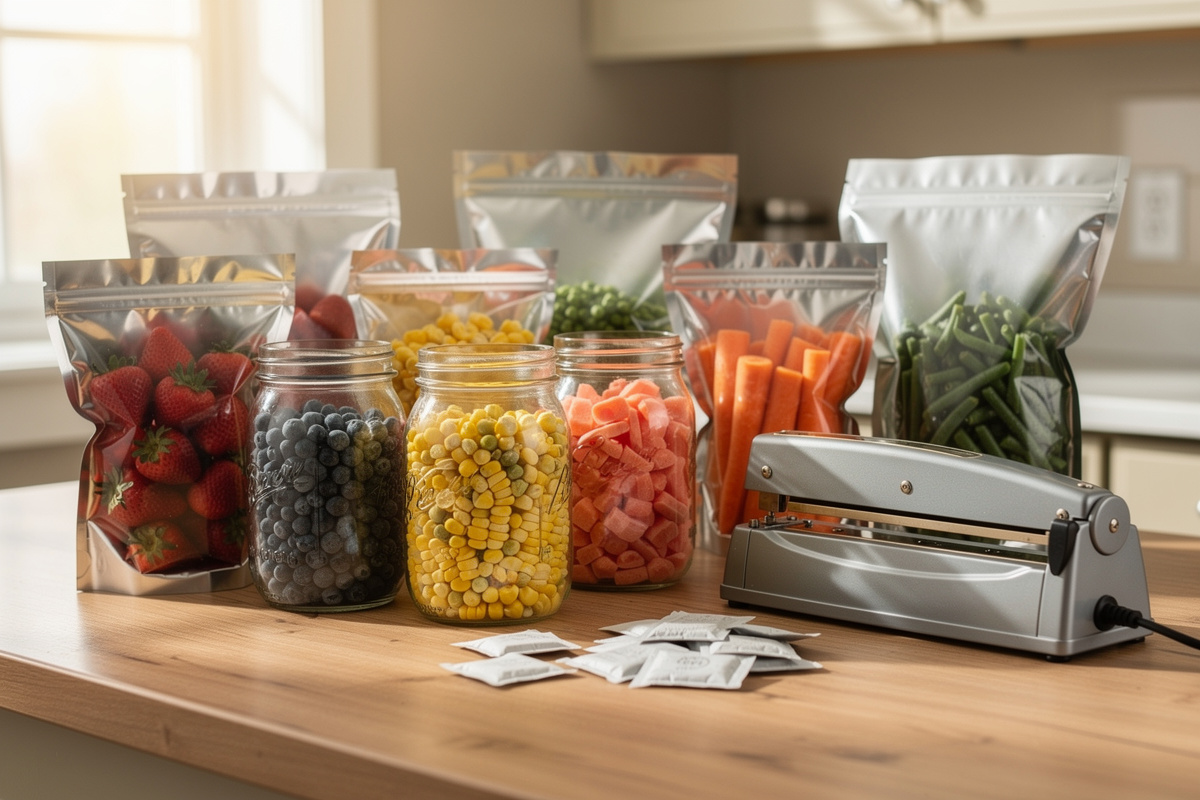

To store freeze dried food, seal it dry, dark, cool, and airtight: mylar bags with a correctly sized oxygen absorber for long-term loads, or canning jars with an absorber for anything you’ll eat within a year. Get those four variables right and commonly reported shelf life runs into years.
Get the moisture or oxygen wrong, though, and you lose the batch. That last clause is the whole reason this guide exists.
That paragraph is the whole game, but it skips the part nobody tells you: storage is where most of my early freeze-drying mistakes actually happened, not in the machine. The cycle ran fine. The packaging failed. I’ve pulled jars out of a cupboard a year later with a soft, leathery surprise inside because I sealed a load that hadn’t passed the dry check, and I’ve watched a mylar bag I trusted slowly puff back up because the oxygen absorber I dropped in was a fraction of the size that volume needed. This guide is the storage system I run now, built from a batch log that records what actually held and what didn’t.
I run a Harvest Right Medium-class machine in a utility room and treat the packaging bench the same way I treat my curing chamber: logs over feelings. Everything below is how I store my own freeze-dried food. Where I touch shelf-life numbers, I’ll point you at USDA and the manufacturer rather than promise you anything, because food safety is the one place this site doesn’t bluff.
What Actually Ruins Freeze Dried Food in Storage?
Three things kill stored freeze-dried food: residual moisture, oxygen, and light, roughly in that order. Moisture is the killer because freeze drying pulls food down to around 1-4% residual moisture, and any that’s left behind feeds spoilage the moment it’s sealed in. Oxygen drives slow oxidation and rancidity, especially in anything fatty. Light degrades color and nutrients over time.
The reason moisture leads the list is that it’s the one you carry in yourself. The machine does its job; then you load a tray that wasn’t fully dry, or you pack a humid kitchen’s air into the bag along with the food. In my batch log, every storage failure traces back to one of those two moisture sources, never to the freeze dryer underperforming. That’s why the dry check before packaging matters more than any bag you buy.
Heat accelerates all three problems at once, which is why a cool, stable spot beats a warm one even if both are technically “dry.” A pantry that swings from 18°C to 30°C with the seasons is working against you in a way a steady 15°C basement shelf is not. You’re not just storing food; you’re slowing chemistry, and chemistry speeds up with temperature.
How Do You Choose Between Mylar Bags and Jars?
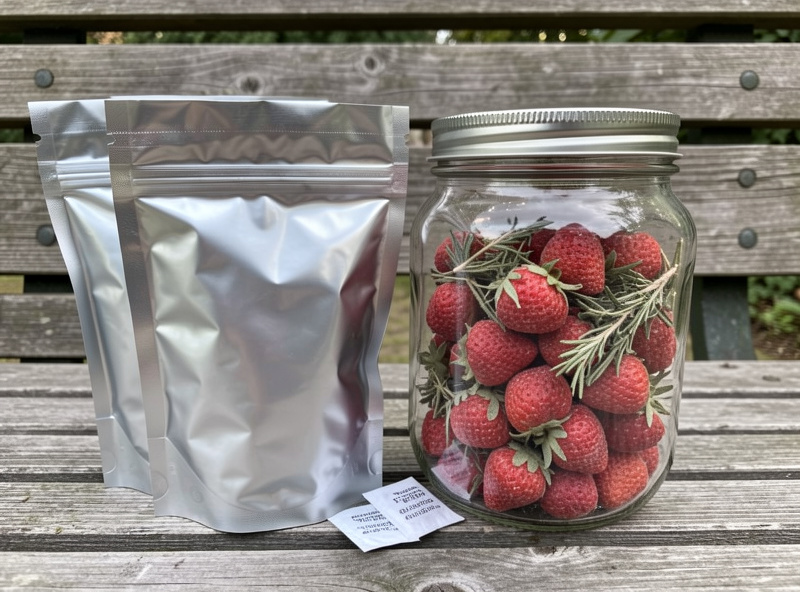
Choose mylar bags plus oxygen absorbers for long-term storage of food you won’t touch for years, and canning jars plus absorbers for anything you’ll open and eat within roughly twelve months. Mylar wins on long-term barrier and space; jars win on reusability, pest resistance, and the ability to reseal after opening.
The honest tradeoff is access versus archive. A mylar bag, once heat-sealed, is a sealed unit: you open it, you commit to using it down or re-sealing it with a fresh absorber. That’s perfect for a year’s worth of strawberries you’re rationing into smoothies, and annoying for the jar of freeze-dried herbs you dip into weekly. Jars solve the access problem completely, and a wide-mouth jar with a fresh absorber reseals cleanly every time, but glass is heavy, breakable, and takes far more shelf space per calorie than a stacked mylar bag.
My own line splits roughly down the middle. Bulk garden glut, meal components, and anything destined for deep storage goes into mylar. Daily-driver items, the snack-grade fruit and the herbs and powders, live in jars on an eye-level shelf where I’ll actually use them before they age. The deeper case for each, including when a jar is genuinely the better long-term call, gets its own treatment in my breakdown of storing freeze-dried food in jars.
How Big an Oxygen Absorber Do You Need?
Size the oxygen absorber to the air volume in the container, not the weight of the food. As a working rule, roughly 300cc of absorber handles a one-gallon mylar bag of dense food, and you scale up for bulkier, airier loads or larger bags. Undersizing is the single most common storage mistake I see, and it’s invisible until the bag re-inflates weeks later.
The reason it trips people is that absorbers are rated in cubic centimeters of oxygen they’ll scavenge, but what matters is the air trapped around your food after sealing. A bag of freeze-dried kale is mostly air; a bag of freeze-dried ground beef is dense. Same bag size, very different absorber demand. When I’m unsure, I round up: an oversized absorber costs pennies and does no harm, while an undersized one quietly fails the whole bag.
There’s a tactile tell I rely on. A mylar bag that sealed well with the right absorber goes hard and slightly vacuum-drawn within a day or two as the oxygen is consumed; the bag “shrink-wraps” itself a little around the contents. If a bag stays soft and pillowy after 48 hours, I treat it as suspect and re-open it. The cubic-centimeter math behind that, and how to actually count the air in a given load, lives in my oxygen absorber sizing chart.
How Do You Seal Mylar Bags So They Actually Hold?
Seal mylar with a continuous, fully-melted band across the bag, leaving the absorber inside and the food pushed below the seal line. An impulse sealer gives the most repeatable result; a household iron or hair straightener works but is far less consistent. The seal is only as good as its weakest millimeter, so you check the whole band, not just the ends.
The mistake I made early was treating the seal like a quick press, the way you’d close a sandwich bag. Mylar needs the foil layers to actually fuse, and that takes the right heat held for the right dwell time. Too little and you get a tacky bond that peels open in a month; too much and you scorch through the foil and create a pinhole. An impulse sealer takes the guesswork out because the heat and dwell are set, but technique still matters: smooth the bag flat, keep the food clear of the seal zone, and run a single clean pass.
My verification habit is simple and it has saved batches. After sealing, I tug the bag firmly from both sides of the seam and run a thumbnail along the band feeling for any soft or unfused spot. A good seal doesn’t give. The full impulse-sealer sealing technique, including how I dial in dwell time for different mylar bag thicknesses, is covered in detail elsewhere in this cluster.
Where Should You Store Sealed Freeze Dried Food?
Store sealed freeze-dried food somewhere cool, dark, dry, and stable: an interior closet, a basement shelf, or a pantry away from the stove and any exterior wall. The target is steady moderate temperature rather than the coldest possible spot, because temperature swings and condensation do more damage than a few degrees of warmth.
People assume colder is always better and reach for the garage or an unheated outbuilding. That’s a trap in any climate with real seasons. A space that cycles between freezing and warm pushes the packaging through expansion and contraction and invites condensation on the bag surface, and in a humid garage that moisture is exactly what you sealed the food away from. I keep my long-term mylar on basement shelving where the temperature barely moves across the year, and my jar shelf indoors where I can see it. The same logic drove where I put the machine itself: a stable, planned spot beats a convenient one.
Light is the quiet variable. Mylar is opaque, so a sealed mylar bag is already light-protected, but jars are not. A jar of freeze-dried raspberries on a sunny windowsill will fade and degrade noticeably faster than the same jar in a cupboard. If your jars live in the open for convenience, keep them out of direct sun, or accept that you’re trading some longevity for visibility and rotating them faster.
How Should You Label and Rotate Your Storage?
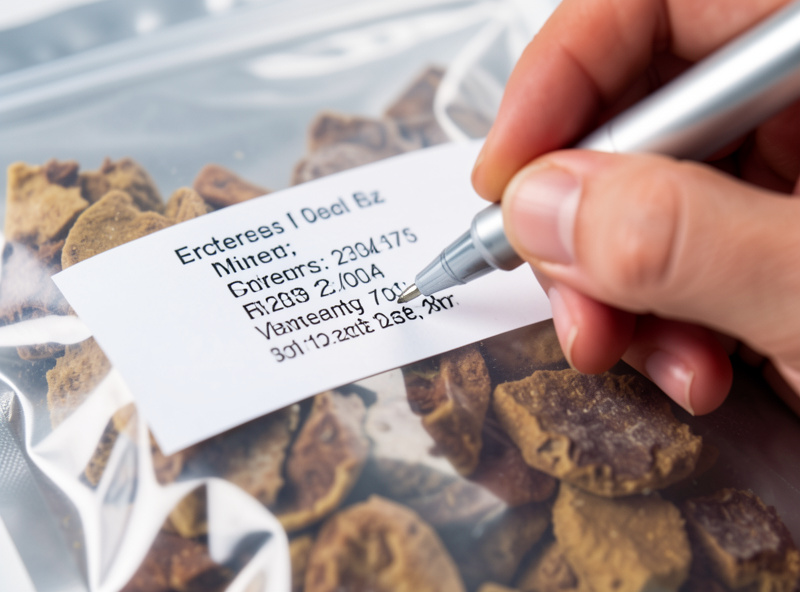
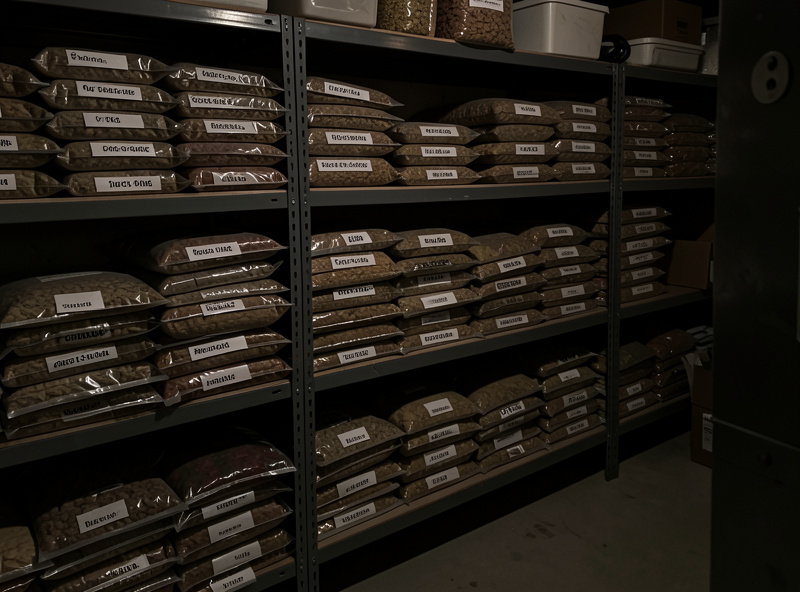
Label every container with contents, batch date, and ideally the load weight, then rotate on first-in-first-out so the oldest stock gets eaten first. Without a label and a system, a long-term store quietly becomes a graveyard of mystery bags, and the whole point of preserving the harvest is lost to forgetting what you have.
This is the part of storage that has nothing to do with bags or absorbers and everything to do with whether the system survives contact with real life. My rule, borrowed straight from how I run the curing chamber, is that an unlabeled container doesn’t exist: if I can’t read what it is and when it went in, I can’t trust it and I can’t rotate it. I write contents and date directly on mylar with a paint pen, and I keep a running index of what’s in deep storage so I’m not excavating shelves to find out.
Rotation is where most home stores fail silently. You build up a year of stock, eat from the front, and keep adding to the front too, so the back never moves. First-in-first-out only works if new stock goes behind old stock, and that one discipline is worth more than any premium bag. The full labeling and rotation system I run, including the index, is its own article in this cluster.
How Does Storing Freeze Dried Food Differ From My Other Preservation Benches?
Freeze-dried storage is the most forgiving of my preservation benches once it’s sealed, but the least forgiving if you seal it wrong. A jar of fermented kraut tells you it’s unhappy by smell and bubble; a cured coppa shows you on its surface; a failed mylar bag of freeze-dried peas says nothing for weeks and then hands you a soft, oxidized mess on opening. The feedback loop is slow and silent, which is exactly why the packaging discipline has to be tighter.
I think of all four benches as the same hobby at different water activities. Fermentation lives wet and biologically active. Curing pulls water out slowly while salt and time do the work, and my curing chamber is constantly readable. Dehydrating leaves more residual moisture than freeze drying, so dehydrated food stores for months rather than years and stays a bit chewy by design. Freeze drying takes water activity lower than any of them, which is what buys the long shelf life, but only if the storage barrier holds. The lesson the curing chamber taught me transfers directly: trust the log and the measurement, not how the food looks through the bag.
The practical upshot is that freeze-dried storage rewards front-loaded effort. You do the careful dry check, the right absorber, the verified seal, and the labeling once, and then the food asks nothing of you for years. My fermentation crocks need tending; my mylar archive just needs a cool dark shelf and an honest rotation system. If a reader’s food is better suited to curing or fermenting, I’d rather send them to the right bench than oversell the machine.
Does Freeze Dried Food Need a Dry Check Before You Store It?
Yes, and skipping it is the single mistake that turns good packaging into a wasted batch. Storage cannot fix a load that left the machine still holding moisture; the absorber and the seal just lock that moisture in with the food. A dry check before packaging is the gate every batch passes in my line, and it takes under a minute per tray.
My check is three steps, all of them cheap. First, the snap test: a fully freeze-dried strawberry or pea snaps and crumbles cleanly, while anything bendy or leathery in the center is still wet and goes back in for more dry time. Second, the weight check against the batch log, because a load that has not lost the moisture weight I expect for that food type is not done regardless of how it looks. Third, the cold-spot pinch on the densest pieces, which are always the last to finish. If any one of the three fails, the whole tray re-runs rather than gets sealed.
This is where the storage bench and the machine bench meet. The reason I trust the snap test at all is that I cross-checked it for years against the log, and the reason I know how long a given food needs is that I track real cycle times by food type and treat the printed estimates as a starting point, not gospel. The fuller version of the doneness routine, including when an apparently finished load actually needs more time, is in my guide to telling if freeze drying is actually done. None of the storage discipline below matters if the food going into the bag is not genuinely dry first.
One honest caveat tied to the ownership reality: the temptation to under-dry is strongest at the end of a long, loud cycle when you want your trays back. That is exactly when discipline matters most. A questionable tray costs you a re-run of a few hours; a questionable tray sealed into mylar costs you the whole bag months later, and you find out only on opening.
What Are the Most Common Storage Mistakes?
The four storage mistakes I see most are sealing food that wasn’t fully dry, undersizing the oxygen absorber, making a weak or incomplete seal, and skipping labels and rotation. Each one is invisible at packing time and only shows up later, which is what makes them so common and so frustrating. Every one of them is in my own early batch log.
Sealing under-dried food is the worst because it can affect safety, not just quality, and there’s no rescuing it from inside a sealed bag. This is the direct argument for a real dry check before packaging: the snap test, the weight-loss verification against the log, and the willingness to run an extra dry cycle rather than commit a questionable load to storage. A load that fails the check goes back in the machine, never into a bag.
The other three are recoverable if you catch them early. An undersized absorber announces itself when the bag stays soft after 48 hours, so a quick squeeze-test of fresh bags catches it. A weak seal reveals itself to the thumbnail test before you shelve the bag. And the labeling failure is the easiest to prevent and the most commonly skipped, because it feels optional in the moment and becomes a problem only months later when you’re staring at an unmarked bag wondering what’s inside and how old it is. None of these are exotic; they’re just the steps people skip when they’re tired at the end of a long cycle.
How Long Does Freeze Dried Food Actually Last in Storage?
Properly dried, oxygen-free, and stored cool and dark, freeze-dried food is commonly reported to last many years, and manufacturers like Harvest Right cite figures in the 25-year range for ideal conditions. Treat those as best-case numbers tied to perfect packaging and storage, not a guarantee for the bag in your closet, and lean on USDA guidance for any food-safety judgment.
I’m deliberately careful here because shelf life is the most over-promised claim in this whole category. The big numbers assume your residual moisture was low enough, your oxygen absorber was sized right, your seal was perfect, and your storage stayed cool and stable for decades. Miss any one of those and the real figure drops, sometimes drastically, and there’s no way to see it from the outside until you open the bag. That’s why this site reports shelf life as “commonly reported under ideal conditions” rather than stamping a date on it.
For practical planning, I treat my own stores conservatively: long-term mylar as multi-year storage I still rotate, and anything in jars as a within-a-year item. The detailed breakdown of how storage conditions actually move those shelf-life numbers, with the USDA and manufacturer framing, is the closing article in this storage cluster. When in doubt, the dry check, the snap test, and your own senses on opening matter more than any printed shelf-life claim.
Frequently Asked Questions
Do you really need oxygen absorbers for freeze dried food?
For long-term storage, yes. Freeze drying removes moisture but not oxygen, and trapped oxygen drives slow oxidation and rancidity, especially in fatty foods. An absorber sized to the container’s air volume protects the batch. Short-term jar storage you’ll eat within months is more forgiving.
Can you store freeze dried food in regular ziploc bags?
Not for long-term storage. Standard ziploc bags are not a true oxygen and moisture barrier, so the food will slowly reabsorb humidity and oxidize. They’re fine for a few weeks of grab-and-go use, but mylar with an absorber or a sealed jar is the standard for anything you want to keep for years.
How do you know if stored freeze dried food has gone bad?
Look for any softness, clumping, color change, or off smell on opening, which all point to moisture or oxygen ingress. Properly stored freeze-dried food stays crisp and snaps cleanly. If a long-term mylar bag stayed soft instead of going hard within a couple of days of sealing, treat it as a failed seal.
Is it better to store freeze dried food in mylar or jars?
Mylar bags plus absorbers are better for long-term, space-efficient, light-protected storage. Jars plus absorbers are better for food you open and eat within about a year, because they reseal cleanly and resist pests. Many home setups use both: mylar for the archive, jars for the daily-driver shelf.
Does freeze dried food need to be kept in the freezer or fridge?
No. Properly dried and sealed freeze-dried food is shelf-stable at moderate room temperature and does not need refrigeration. A cool, dark, stable spot like an interior closet or basement shelf is ideal. Avoid the freezer for finished sealed stores; it adds no benefit and risks condensation when removed.
What temperature is best for storing freeze dried food?
A cool, stable temperature beats the coldest possible spot. Steady moderate conditions around a cellar or interior-closet range are ideal because temperature swings cause expansion, contraction, and condensation that damage packaging. Avoid garages and spaces near a stove or exterior wall where temperatures cycle widely.
How the Storage Methods Compare
| Method | Best for | Light protection | Resealable | Space efficiency | Reported longevity |
|---|---|---|---|---|---|
| Mylar bag + O2 absorber | Long-term archive, bulk loads | Excellent (opaque) | No (heat-sealed) | High (stackable, flat) | Years, manufacturer-cited up to 25 in ideal conditions |
| Canning jar + O2 absorber | Within-a-year daily-driver items | Poor (clear glass) | Yes (reseal with fresh absorber) | Low (bulky, breakable) | Commonly reported around a year for opened-and-resealed use |
| Vacuum-sealed bag | Short-to-mid storage, freezer backup | Varies by bag | Re-seal possible | Medium | Shorter without an absorber; oxygen not fully removed |
| Standard ziploc bag | Grab-and-go, days to weeks only | Poor | Yes | Medium | Not a true barrier; not for long-term |